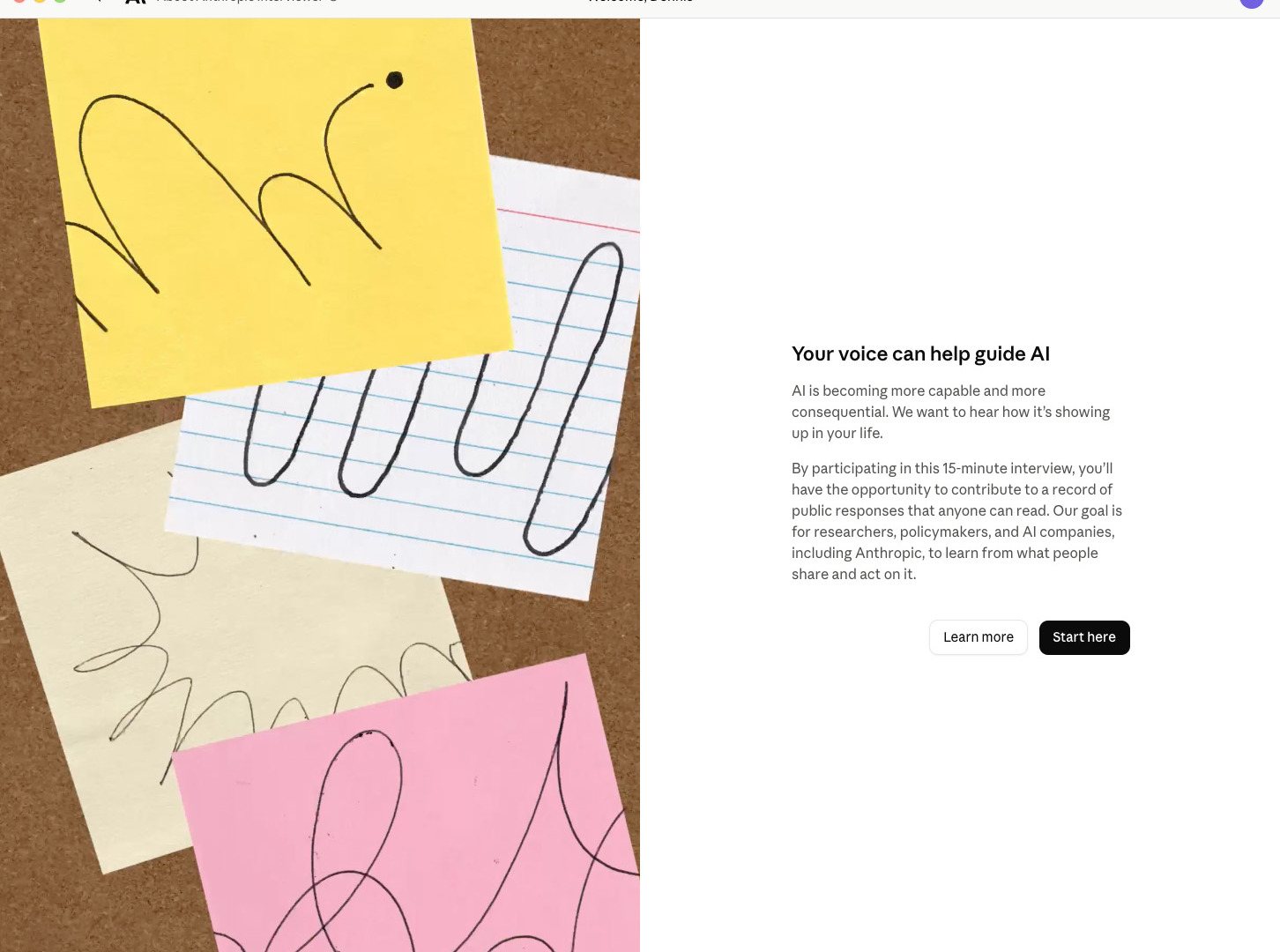
This morning, when I opened the Claude desktop app, I saw a screen inviting me to participate in an “interview” about my thoughts on AI. The study is called “What do you want from AI?”
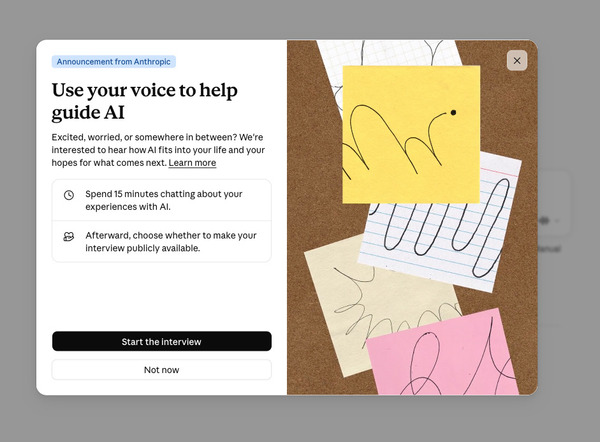
Because I’m a design researcher and intensely interested in AI, I was moved to participate. I was interested in Anthropic’s research methods and research design. And I was also curious what an interview with Anthropic’s research tool, Anthropic Interviewer, would be like.
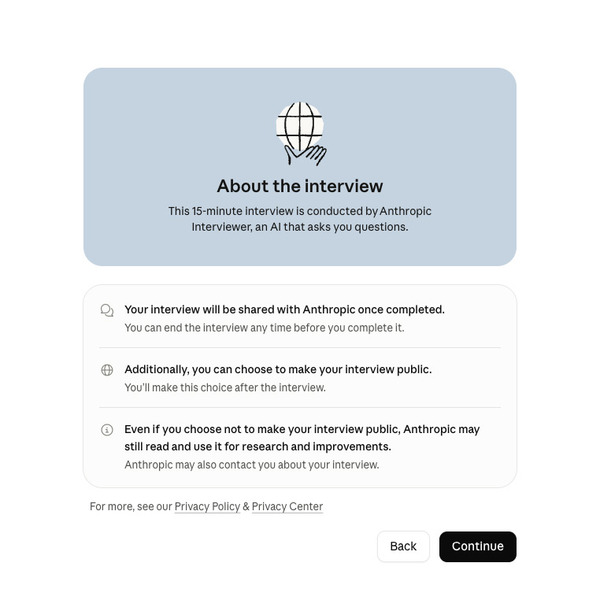
The interview started with typical informed consent information we require of human researchers. Before I responded, I knew what to expect and how my responses would be used. Throughout the interview, on every screen, participants were reminded, “Avoid sharing personal or other sensitive information.” Nice job, Anthropic design researchers.
I used voice-to-text to participate in the interview. Unfortunately, one of my responses included a reference to “Bitcoin” because text-to-speech muddled my response. Anthropic Interviewer recovered nicely—asking for clarification. Not bad.
At times, I felt like the “interviewer” led me a little, but this felt like a semi-structured interview where the questions are pretty standard for all participants, and the interviewer can stray a little to ask for clarifications or build on salient ideas. I wonder how Anthropic will analyze the data. I hope human researchers will read and analyze it—qualitative data need human eyes and interpretation.
At the end of my interview, Anthropic provided the transcript below. (If you’re wondering how I got this back-and-forth exchange to display the way it does, I built a custom block for the WordPress content management system just for these kinds of transcripts.)
If you would like to participate, visit What do you want from AI? at Anthropic.com.
Claude
Hello! I’m an AI interviewer from Anthropic. As AI is becoming more capable and more consequential, we want to hear how it’s showing up in your life.
Please don’t share anything private such as health details, personal information, or identifiable information about others.
Ready to start?
Me
Yes! Let’s begin.
Claude
Great, let’s dive in.
To start, what’s the last thing you used AI for?
Me
Claude helped me think through a communication plan to keep people in my organization informed in a way that matches our values, but also doesn’t add drag to people’s days. It was a helpful session where I collaborated with the tool.
Claude
That sounds like a balancing act — getting people informed without adding to their load. Thanks for setting the scene.
Can you tell me about your most memorable moment with AI?
Me
I am new to vintage auto repair and I used a Claude Project with documents about a vintage car I recently purchased. During the repair process, I shared images of what I was seeing in the hood, to diagnose a problem, I was installing a starter and it was a repair I had never done before. Claude helped me check my work and identify parts of the car that the shop manual did not detail very well. The repair went well and it was helpful to have feedback while I was working on the project. It was an unnerving experience because I was afraid I would break the car, but Claude plus other resources I found on the web and the shop manual guided me through and it made me a better mechanic. Now what I work on the car, I am way more confident and I understand how it works without having to use the tools.
Claude
That’s a vivid one — learning a repair you’d never done, with the fear of breaking the car hanging over it, and coming out the other side more confident.
What was it about that experience that has stayed with you?
Me
It underscored the importance of intent when using AI tools. If I am intent on using tools to improve my knowledge and skills, then AI tools actually make me smarter and take me further. It was like having an expert mechanic work alongside me, and I feel like I’m moving from being an apprentice to being a more capable mechanic.
Claude
The distinction you’re drawing between intent to learn versus something else is interesting — and the apprentice-to-capable-mechanic framing is clear.
You’ve told me about the starter repair and how it built your skills. Beyond that, is there another time AI made something better, for you or for people around you?
Me
Last year, I became more intentional about my bucket list items and making sure I don’t sacrifice the things that really matter to me. In a very long conversation with Claude, we discussed about 90 bucket list items I had collected over the years and categorized them into groupings that have now become important concepts of my life. Claude was helpful in identifying patterns in my own bucket list items and in a collaborative process, we identified areas that are meaningful to me. It was helpful to have what seemed like an objective voice on the outside of me, reflecting back some of the things I took for granted or patterns that I’d neglected. It has helped me to be more intentional about relationships and parenting advice in private, and just getting outside to go camp that make me a better person in my work and in my interpersonal relationships. This has helped me to delete some of the things that were noise in my life and identify the things that really mattered. I think that’s made me a more balanced person and people around me have said that I seen more at peace. I could’ve done all this stuff on my own, but it was nice to systematically explore those bucket list items in a back-and-forth way.
Claude
That’s a substantial shift — going from 90 scattered items to categories that shaped how you spend your time, and having people around you notice you seem more at peace.
On the flip side, tell me about a time AI made something worse, for you or for people around you. What happened?
Me
I am a professor and I have only had a few students use AI to produce content they claimed as their own. But I have several colleagues who have been very frustrated that students have not taken the time to produce their own work—instead, using AI tools to complete assignments and then move on to the next thing. It is hard for educators who care deeply about developing human beings and coaching students to grow. It feels like it challenges professors’ identity as educators, and then also a great deal of disappointment wells up because they see how students could be so much more but are choosing to shortcut their learning. Again, I’ve only witnessed this a few times myself, but it is disheartening and it feels like it cheapens the effort I put into facilitating an engaging and transformative learning experience for students.
Claude
That connects directly back to what you said about intent — the same tool that took you from apprentice toward capable mechanic being used by students to skip the growing part entirely.
We’re a bit over halfway through. Is there anything you’ve decided not to use AI for, or something you do use it for that makes you uneasy?
Me
I never use AI to produce 100% of final written content that goes out to the public that’s supposed to be purely ME. This is especially important for any social media content or content that I put on my website, or emails to people I lead. Authenticity is crucial, and using AI to produce this final content feels like I don’t value my readers because I didn’t do a substantial amount of the work. The care I put into writing something shows how much the reader means to me. That doesn’t mean I don’t use AI for written text that is more operational, but even then, I have tried using AI tools to produce that content as a first draft, and I wind up erasing most of it and writing the rest from scratch.
Claude
The link between the care you put in and what it signals to the reader is a clear line. And it sounds like even on the operational side, the drafts often don’t survive.
How did you arrive at that boundary?
Me
Gosh, that’s a good question because it has emerged over time. Interestingly, I started out using AI to produce low-stakes content and keeping it more often than not. That was probably a year and a half or two years ago. But in the last year, I feel like my own personal style guide and boundaries have developed through practice. Let me say it this way, every time I write, I am shaping my own AI policy and it tightens in ways based on the context. Every new thing I write for a different audience tests out how AI can assist in that process in ways it can be damaging. This makes me think, I wonder how we can develop this in the people we lead or in students. It’s a metacognitive approach to defining one’s own standards. This requires being aware of one’s own thinking, but if we could do that, that’s a developmental approach that could be quite promising. This gives me a lot to think about.
Claude
“Every time I write, I am shaping my own AI policy” — that’s a striking way to put it, and interesting that your practice tightened rather than loosened as you got more experienced with the tools.
Given what you’ve seen, is there anything about how the world works — work, school, healthcare, government — that you’d like AI to help change?
Me
AI tools are extraordinary at identifying patterns, so I think there’s so much hope when we look at systemic design for AI to assist identifying patterns in areas like healthcare with disease, or climate and weather patterns and drought, or my favorite, and, human brains likely cannot wrap themselves around how complex structures are and their interconnections. AI can help us to better understand the universe and ourselves. I have great hope there.
Claude
Systemic pattern-finding at a scale human brains can’t hold — from disease to drought to understanding ourselves.
Conversely, is there anything you wouldn’t want AI to change?
Me
AI that does not enhance people’s potential should be avoided at all costs. If AI tools create barriers that prevent interpersonal relationships, or if AI tools become a surrogate for deep connection with other people with ourselves, we risk losing the ability to be human. There is a wondrous messiness and developmental opportunity when people create from the very beginning to the very end. The struggle of creating something is how we learn about our craft and about ourselves. So, I struggle at times with how AI can augment or supplement the way we create and sometimes how it could short circuit the benefits of the messy creative process. This applies to science and discoveries, as well as the arts and design—creating a logo or a poem.
Claude
The “wondrous messiness” of creating something from beginning to end, and the worry that AI could short-circuit exactly the part where the learning happens — that ties back to what you saw with students.
Given that, is there anything you’d want Anthropic to do, or do differently?
Me
So much of AI use is about intent and self-control. As a designer, if I were at anthropic, I might explore ways for AI tools to remind users of ways AI use might reduce the developmental benefits of solving a problem that’s complicated. This is a tricky one though. Because designing a tool that has limits steers people to a certain kind of outcome or use. I don’t love limits put on tools, but I do see some benefit to making explicit the process of use and what someone would get out of that use, or would sacrifice because of use. Perhaps, when people use an anthropic tool, the tool might give users an option for for Bitcoin users is to use the tool to discover during the process of use. It’s almost like there’s a warning label or some kind of contextualization on the use experience before beginning. It would intent. Gee, there’s definitely a theme in my responses, aren’t there?
Claude
There is — intent has run through nearly everything you’ve said. And the tension you’re naming is real: making the tradeoffs explicit without the tool deciding for people what they should want.
I noticed a few words in that response may have come through garbled — the part about “an option for Bitcoin users.” Would you say more about what that option would look like in practice?
Me
Oops. I am using voice to text, and that sentence did not render correctly. I will correct it below:
Perhaps, when people use an Anthropic tool, the tool might give users an option for the mode of use before the session starts. Options like 1) discovery: use the tool to expand thinking and produce insights; 2) operational: use the tool to get something done in a short amount of time. Etc.
Claude
That’s much clearer, thanks for the correction — declaring the mode up front, discovery versus operational, so the intent is explicit before the session rather than implied.
Thank you so much for sharing all of that with me. What you said about shaping your own AI policy every time you write is really valuable, and I appreciate your honesty about both the confidence you gained working on your car and the disappointment you and your colleagues feel when students shortcut their learning.
Before we wrap up, one final question: is there anything else about AI or its role in your life or society that you think is important for us to understand? Anything we didn’t cover that you’d like to share?
Me
I appreciate that Anthropic is doing a study like this. As a researcher myself, it is important to involve participants in the co-creative process. Though participatory design complicates the design process and adds a lot of drag and time, AI has such significant benefits and downsides potentially that it is important for users from many different backgrounds to be involved in that creative process. I understand it’s a balance. But I encourage Anthropic to continue seeking people’s insights.
Claude
Thank you — that encouragement toward participatory design, complications and all, is noted.
Thank you again for your time and thoughtfulness today. Your perspective helps us see both how AI is impacting your life today and what you want protected or changed as it develops. The team at Anthropic is excited to discover what patterns emerge from all these conversations. We’ll release everything you allow us to share, analyze it for our societal impacts research, publish what we find, and use it to build a Claude that reflects what we’ve learned.